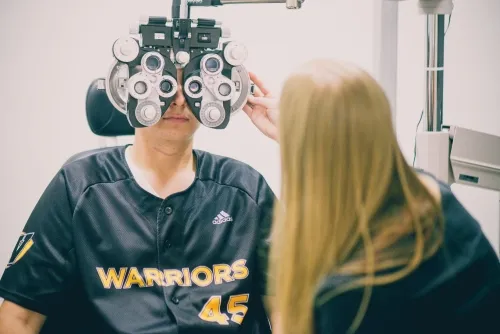
Two Licenses, One Lease: A Framework for Dual-Optometry Couples Making Career Decisions Together

Photo: kargaltsev, CC BY 2.0, via Wikimedia Commons
Two optometrists in one household sounds, on paper, like a pleasant symmetry: shared vocabulary, shared schedule pressures, shared understanding of what a Saturday refraction block actually feels like. In practice, it means two licenses, two job markets, and one lease. Every relocation decision has to be made twice over, and every compromise has a co-signer.
The couples who handle this well are not the ones who communicate best in the abstract. They are the ones who have built a repeatable process — a set of rules agreed to before the offers arrive, when nobody is negotiating from a position of excitement or panic.
The Math Most Couples Skip
Optometry careers are unusually sensitive to geography in ways that are easy to underestimate. Reimbursement patterns vary by state and by payer mix. Scope of practice law varies, which affects both what a license is worth and which credentials are worth pursuing. A practice that would be a strong purchase in one metro may be a poor one forty minutes away because of saturation.
That means the two-body problem for optometry couples is not simply finding two jobs in one city. It is finding two careers that can both develop in one labor market. A couple where one partner wants ownership and the other wants a hospital-based specialty clinic is looking at a much narrower set of viable metros than either would face alone.
Rule One: Sequence, Do Not Negotiate Simultaneously
Simultaneous search is the single most common error. Both partners interview, both receive offers with two-week exploding deadlines, and the couple ends up making a permanent decision under artificial time pressure that favors whoever's offer arrived first.
A better structure is sequential with transparency. One partner leads a search cycle while the other builds a target list and begins informal conversations but does not enter active negotiation. The leading partner's offer is then used to define a geography, and the trailing partner negotiates with a known city and a known timeline.
The obvious objection is that this costs the trailing partner leverage. It does, and that cost should be acknowledged and priced. Many couples offset it by giving the trailing partner the next cycle as the lead, with the first partner agreeing in advance to follow.
The Three-Year Ledger
Most couples who claim their moves are equal are actually tracking informally, badly, and with selective memory. A written ledger is less romantic and considerably more durable.
The ledger has three columns: whose career the last relocation favored, by how much, and what the other partner received in exchange. 'By how much' does not need to be precise. A simple ordinal scale works — a major move that required the other partner to abandon a practice or a partnership track, a moderate move that changed commute or patient population, or a neutral move where both careers were roughly equally served.
Reviewed annually, the ledger catches the pattern that ruins dual-career households: one partner's career quietly becoming the default priority across three consecutive cycles because each individual decision seemed reasonable at the time.
Sunset Clauses and Commuting Windows
Two mechanisms turn vague promises into workable arrangements.
A sunset clause sets an expiration date on an arrangement that is unequal by design. If one partner takes a lower-paying or less-advancing role to make a relocation work, the couple writes down when that sacrifice is revisited — typically eighteen to thirty-six months out, with specific triggers such as a partnership decision, a contract renewal, or a licensure milestone.
A commuting window is a bounded period of long-distance living with a defined end. A twelve-to-eighteen-month window with pre-agreed visit frequency, budget, and an exit condition is survivable and often necessary. An open-ended separation that everyone hopes will resolve itself is not a plan; it is a slow erosion.
Remote, Part-Time, and Hybrid as Real Options
Optometry has less remote capacity than many professions, but it is not zero. Teleoptometry roles, prior-authorization and utilization review consulting, clinical documentation work, and hybrid administrative positions exist, and they are increasingly viable as one partner's secondary income stream during a transition.
Part-time clinical work is the more common lever. A four-day or three-day schedule at a stable practice can preserve licensure, maintain clinical skills, and keep one partner professionally connected during a period when the other is building something. The tradeoff is real — part-time roles often carry no benefits and can become career cul-de-sacs if left unexamined for years — so the arrangement should be time-boxed with a review date.
Licensure Timing Is a Career Decision
State licensure is not an afterthought in a relocation; it is a calendar constraint that determines who can start earning when. Applications, examinations where required, and processing times vary widely. A couple planning a cross-state move should map the timeline backward from the target start date, identify which partner needs licensure first, and budget the fees and the gap in income.
If the destination state has a compact or portability pathway in place, verify eligibility early rather than assuming it applies. Paperwork discovered late is the most expensive kind.
What to Negotiate Before Either of You Signs
Employers rarely volunteer the terms that matter most to dual-career households, but several are negotiable more often than optometrists expect: a defined schedule rather than an open one, a delayed start date that allows a partner to finish a credential, relocation assistance, a shorter or narrower non-compete, and a probationary review at six months.
It is also worth raising the trailing partner's situation explicitly during negotiation. Some practices will facilitate an introduction to a nearby group, and those introductions occasionally turn into placements.
When the Answer Is No
Not every geography supports two optometry careers at the level both partners want. Recognizing that early is a kindness. If one market cannot sustain both, the honest options are to change the market, to change the career shape for one partner — ownership to associate, full-time to part-time, clinical to administrative — or to accept a commuting arrangement with a defined horizon.
What does not work is the fourth option most couples default to: moving anyway and hoping the trailing partner's career recovers on its own. It usually does not, and the ledger records it either way.